

Diving in Indonesia means warm water and some of the richest reefs on the planet, spread across regions that each feel completely different: soft-coral walls in Raja Ampat, ripping drift dives in Komodo, cold upwellings off Bali and the black-sand muck of North Sulawesi. The signature encounters are reef mantas at cleaning stations, the strange bumphead sunfish off Nusa Penida in season, and macro animals like the mimic octopus that most divers have only seen in documentaries.
LiveAboard.com doesn't sponsor this guide and doesn't see it before it's published - we recommend them because it's useful information for planning your trip. If you book through our links, we may earn a small commission at no extra cost to you.
A reef manta hangs over a coral head with its mouth half open. It barely moves its wings while small cleaner wrasse work over its gills like a pit crew. Below it, a wobbegong that looks like a shag rug with teeth lies on a ledge, and a school of fusiliers pours past as if it has somewhere to be. That is a fairly ordinary morning dive in eastern Indonesia. The country sits in the middle of the Coral Triangle, the region with the highest diversity of reef-building corals and reef fish on Earth. Divers of every level can find something here. Newer divers do well on Bali's calm house reefs and Bunaken's walls. Divers who love current head for Komodo. Photographers go to Lembeh and often forget to come back. The hard part is not finding good diving. It is choosing where to go. If you already know you want to go, you can compare boats and dates on LiveAboard.com. If you are still working out which part of Indonesia suits you, read on.
When is the best time to dive Indonesia?
You can dive somewhere in Indonesia every month of the year. Indonesia spans several monsoon zones, though, so the best months for one region can be the worst for another. Liveaboards follow the weather around the archipelago for exactly this reason.
Raja Ampat
October to April is generally the calmest and most popular window, with flatter seas and good visibility. The water stays warm all year at roughly 27-30 degrees C. From about mid-June to mid-September the southeast monsoon makes the south rougher, and many liveaboards move elsewhere. A 3mm wetsuit is plenty for most people.
Komodo
Komodo is diveable year-round. The north of the park is warm and clear. The south is fed by cold upwelling from the Indian Ocean, with surface temperatures reported around 22-25 degrees C and colder pockets below. Several operators say southern manta aggregations peak during the rainy season, roughly December to March. Wear a 3mm in the north. For the south, bring a 5mm and a hood, and do not let anyone talk you out of the hood.
Bali and Nusa Penida
Bali works all year. Around Nusa Penida, sunfish season usually runs from about July to October. It comes with cold upwelling, and operators report temperatures at depth of roughly 16-22 degrees C, while the surface can sit around 26-28 degrees C. That is a big thermocline. A 5mm with a hood is sensible in season. A 3mm is fine on the north and east coast of Bali for most of the year.
North Sulawesi
Lembeh and Bunaken are dived year-round and the water is generally warm. Muck dives are long, slow and mostly spent lying still, so you lose heat faster than you expect. Many regulars wear a 5mm for that reason, not because the water is cold.

Raja Ampat: the reef that breaks the species counters
Raja Ampat, off the western tip of New Guinea in Southwest Papua province, is the region most divers picture when they think of Indonesia. You get limestone islands like upturned teacups, reefs crowded with fish, and a marine park permit you will need before you dive. The area is huge, so divers usually talk about it in three parts: the Dampier Strait in the centre, Misool in the south and the remote islands of the north.
Conditions: currents run from gentle to properly sporting, especially in the channels of the Dampier Strait, where they bring in the fish life. Visibility is generally good to very good and drops when plankton blooms. The plankton is also what feeds the mantas, so nobody complains much.
What you will commonly see: in the Dampier Strait, reef mantas (Mobula alfredi) are commonly seen at cleaning stations, hovering in place while small fish tidy them up. The tasselled wobbegong (Eucrossorhinus dasypogon) lies under table corals so still that half the group swims straight past it. At night or at dusk, look for the Raja Ampat epaulette shark (Hemiscyllium freycineti), which walks across the reef on its fins as if it never fully committed to swimming. Blacktip reef sharks (Carcharhinus melanopterus) and whitetip reef sharks (Triaenodon obesus) are the sharks most divers see here. Grey reef sharks (Carcharhinus amblyrhynchos) are mainly a Misool sighting. They are not common in the Dampier Strait or the north.
Who it suits: intermediate divers and up. Many sites are fine for newer divers in calm conditions, but some current dives call for confident buoyancy and a calm head.
How to reach it: liveaboard is the best way to cover the area, and the only practical way to see Misool and the north together. A good number of resorts also run day boats, particularly around the Dampier Strait and in Misool.
Insider tip: Raja Ampat is remote. Bring spare o-rings, a spare mask strap, plenty of batteries and whatever medication you need. Nobody is popping out to a dive shop, and if a mask strap snaps on day two, you are diving the rest of the trip with a problem you could have solved for the price of a coffee.
Komodo: currents, mantas and the odd dragon
Komodo National Park lies between Sumbawa and Flores and is a UNESCO World Heritage Site. It is known for strong tidal currents that pump nutrients through narrow channels between the islands, and for the very large lizards that live on land. The north is warm, clear and blue. The south is green, cold, plankton-rich and full of life.
Conditions: Komodo's currents are the real deal. They can switch direction, create down-currents and turn a relaxed drift into a fast ride with the guide pointing at things you see for half a second. Visibility is generally better in the north and lower in the plankton-rich south.
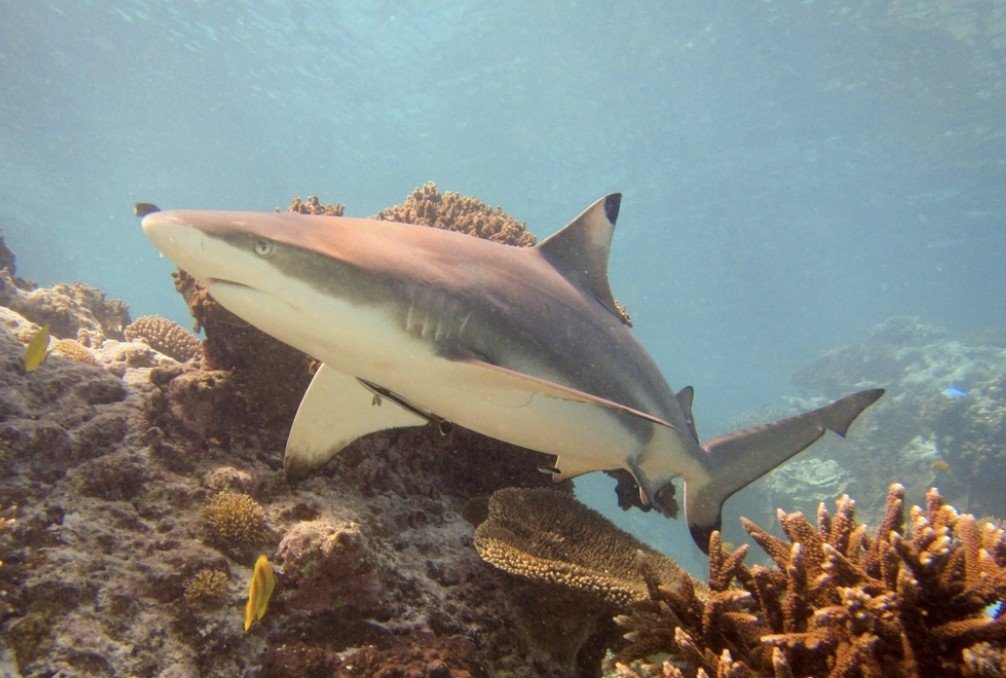
What you will commonly see: blacktip reef sharks (Carcharhinus melanopterus) and whitetip reef sharks (Triaenodon obesus) are the common sharks here. Grey reef sharks are not common in Komodo, whatever the brochures suggest. Brown-banded bamboo sharks (Chiloscyllium punctatum) can be found tucked under ledges, looking like they would rather not be disturbed. Reef mantas (Mobula alfredi) are commonly encountered in the central park and in the south, where they line up at cleaning stations and feed in the plankton-heavy water. Green turtles (Chelonia mydas) and hawksbill turtles (Eretmochelys imbricata) graze the reefs as if the current were someone else's problem.
Who it suits: experienced divers get the most from Komodo. There are sheltered sites for less experienced divers, but you should be comfortable with current, negative entries and deploying an SMB before you book the trip.
How to reach it: both liveaboards and day boats leave from Labuan Bajo on Flores. Day boats cover the central and northern sites well. A Komodo liveaboard lets you reach the south and time dives with the tides.
Insider tip: in Komodo, the dive plan depends on the tide table, not the clock. The best guides plan around slack water and the moment the current changes, so the schedule can change at short notice. Trust it. The guide who makes you wait twenty minutes on the boat is usually the one who saves you from a down-current.
Bali and Nusa Penida: wrecks, mantas and a very strange fish
Bali is where many divers start their Indonesian diving, and it is easy to see why: big airport, easy logistics and a huge range of diving within a couple of hours' drive. The north and east coasts have calm, warm sites and black-sand macro diving. Nusa Penida, a short boat ride off the southeast coast, has cold, fast water and big animals.
Conditions: the east coast around Tulamben is usually calm and straightforward. Nusa Penida is not. It has strong currents and sudden thermoclines, and the water can drop several degrees between one fin kick and the next.
What you will commonly see: at Tulamben, the USAT Liberty wreck lies just off a stony beach. Schools of bumphead parrotfish (Bolbometopon muricatum) are commonly seen around the wreck and nearby reef in the early morning, crunching coral loudly enough to hear. Off Nusa Penida, reef mantas (Mobula alfredi) visit cleaning stations year-round. In season, the bumphead sunfish (Mola alexandrini) comes up from deep water to be cleaned by bannerfish. It is a huge, flat fish that seems to be missing its back half, and it has the blank expression of someone who walked into a room and forgot why.
Who it suits: beginners do well on the Bali mainland. Nusa Penida's current sites are better for intermediate and advanced divers, and good operators will check your experience before they take you.
How to reach it: mostly land-based. Day trips and shore dives run from resorts on the mainland, and fast boats from Sanur go to Nusa Penida and Nusa Lembongan.
Insider tip: in peak season, the popular Nusa Penida sites can get busy with boats. Ask your operator about early departures. Being first in the water often means you have the site, and the calm water, nearly to yourself.
North Sulawesi: Lembeh and Bunaken, critter central
At the northeastern tip of Sulawesi, two of Indonesia's best-known dive areas sit an hour or two apart and could hardly be more different. Bunaken National Park has steep walls dropping into blue water off Manado. The Lembeh Strait, near Bitung, has dark volcanic sand and is one of the world's most famous muck diving areas. It looks like nothing at first, then turns out to be full of strange animals.
Conditions: Lembeh is usually sheltered, with little current and modest visibility. Bunaken's walls have mild to moderate currents and generally better visibility.
What you will commonly see: in Lembeh, the mimic octopus (Thaumoctopus mimicus) flattens itself and shape-shifts across the sand, and the wunderpus (Wunderpus photogenicus) shows off its striped arms as if posing for a photo. Hairy frogfish (Antennarius striatus) sit very still and wave a lure on their heads to fish for their dinner. Nudibranchs are everywhere, including the electric-blue Anna's chromodoris (Chromodoris annae). On Bunaken's walls, green turtles (Chelonia mydas) are commonly encountered, often resting on ledges or drifting up to breathe right in front of your mask.
Who it suits: almost everyone. Lembeh suits divers with good buoyancy, because one careless fin kick can bury the subject and annoy the photographer next to you. Bunaken works well for newer divers in calm conditions.
How to reach it: mostly resort-based, with day boats. Many divers split a trip between Bunaken and Lembeh.
Insider tip: muck diving rewards patience more than distance. Agree on a slow pace with your guide, bring a good torch to light up colours in the dim water, and accept that you might cover fifty metres in seventy minutes. The macro photographer who surfaces with 400 photos of the same goby is not lost. They are having the best day of their life.
What marine life will you see in Indonesia?
Big animals
Reef mantas (Mobula alfredi) are Indonesia's headline big animal and are commonly seen in Raja Ampat, Komodo and Nusa Penida. Oceanic mantas (Mobula birostris) are also recorded in Indonesian waters but are seen less reliably. Blacktip and whitetip reef sharks are the sharks most divers meet. Grey reef sharks are mainly a Misool sighting. In Cenderawasih Bay, on the north coast of Indonesian New Guinea, whale sharks (Rhincodon typus) famously gather around the fishing platforms, and some specialist liveaboard routes go there. In season, the bumphead sunfish (Mola alexandrini) is the big draw in Bali. Turtles turn up nearly everywhere.
Reef life
Expect enormous variety: schools of fusiliers, sweetlips and batfish, giant clams, anemonefish in every shade, and bumphead parrotfish (Bolbometopon muricatum) moving across the reef like a herd of grumpy bison. Wobbegongs and walking sharks give Raja Ampat its particular character. Soft-coral walls in Misool and southern Komodo are some of the most colourful anywhere.
Macro
Indonesia is one of the world's top macro destinations. Look for pygmy seahorses (Hippocampus bargibanti) on gorgonian sea fans, ornate ghost pipefish (Solenostomus paradoxus) hanging head-down near crinoids, peacock mantis shrimp (Odontodactylus scyllarus) punching things in rubble, and more nudibranch species than any one person can learn. Your guide will find a pygmy seahorse on a sea fan from four metres away. You will stare at the same fan for a full minute and see a sea fan.
Liveaboard or land-based?
Honestly, it depends on the region and how you like to travel.
Liveaboard pros: you reach remote sites that resorts cannot, you dive three or four times a day without any travel time, and you can follow the conditions. In Raja Ampat and southern Komodo, that access makes a real difference. Many Indonesian liveaboard trips run about 7 to 12 nights, and some longer itineraries link regions, such as Komodo to Raja Ampat via the Banda Sea.
Liveaboard cons: you are committed to the boat. That is not ideal for non-divers, anyone prone to seasickness, or anyone who wants a slow morning on land. Trips are also often booked well ahead for peak months.
Land-based pros: flexibility, more space, easy days off and better options for non-diving partners. Bali and North Sulawesi are naturally land-based destinations, and Raja Ampat has a good spread of resorts too.
Land-based cons: you only reach what a day boat can get to, and on busy coasts you share sites with other operators.
If Raja Ampat is your goal and you want to cover more than one area, a liveaboard is the usual answer. LiveAboard.com's Raja Ampat listings make it easy to compare routes, since some boats focus on Misool and others on the north. For Bali and Lembeh, staying on land works very well.
How do you get to Indonesia's dive regions?
Most international divers arrive through Jakarta (Soekarno-Hatta) or Bali (Ngurah Rai, Denpasar), then take a domestic flight on to their dive area:
- Raja Ampat: fly to Sorong. Liveaboards usually board in Sorong, and resort guests often take the ferry to Waisai or a resort transfer.
- Komodo: fly to Labuan Bajo on Flores, where most liveaboards and day boats are based.
- Bali and Nusa Penida: you are already there. Transfer by road to Tulamben or Amed, or take a fast boat from Sanur to the Nusa islands.
- North Sulawesi: fly to Manado. Bunaken is a short boat ride away, and Lembeh is reached by road via Bitung.
Domestic schedules in eastern Indonesia change often, so leave a buffer day before a liveaboard departs. Entry requirements for Indonesia also change, so check the current rules with official government sources before you book.
Planning tips
- Certification and experience: Open Water is enough for Bali, Bunaken and many Raja Ampat sites. For Komodo and Nusa Penida's current sites, Advanced Open Water and a good number of logged dives make the trip much more enjoyable, and some operators ask for them.
- Nitrox: widely available on liveaboards and at many resorts, and worth having when you are doing three or four dives a day. Get certified before you travel if you can.
- Dive insurance: essential. Many Indonesian dive areas are a long way from a recompression chamber and a hospital, so make sure your policy covers evacuation.
- Reef hook: useful in Komodo and some Raja Ampat channels. Hook only onto dead rock, and only where your guide says it is appropriate.
- SMB: carry your own surface marker buoy everywhere, and practise deploying it. Drifting in current means surfacing away from the group sometimes.
- Torch: a primary torch for night and muck dives, and a small backup for looking under ledges. Even daytime dives benefit from one, because colours vanish fast at depth.
- Air consumption: your gas usage in Komodo current may surprise you. That is normal, and it is also why the guide keeps asking how much air you have left.
- No-fly time: wait at least 18 hours after repetitive diving before you fly. Remember this on multi-region trips with domestic flights between them.
Booking your trip
Once you have picked your region and season, the easiest way to see what is running is to compare itineraries side by side on LiveAboard.com.
Why I recommend LiveAboard.com
I've worked on liveaboards for 13 years. I've booked through LiveAboard.com many times, and so have a lot of my guests. They don't sponsor Fins and they don't see what we write. Here's why I point people to them:
- The biggest choice of boats. In most of the places we dive, they list more boats and departure dates than anyone else, so you can compare everything in one place.
- You don't pay more. Booking through them doesn't cost more than booking with the boat directly, and you get some of the most competitive prices around.
- Service that actually helps. They answer questions quickly and help with the planning before your trip and with anything that comes up after it.
If you're not sure which boat or itinerary is right for you, they're a great place to start: compare liveaboards in Indonesia.
Before you go: get Fins
Know what you're looking at. Fins is a marine life ID app built by divers. Before your trip, use it to get to know the animals you're likely to meet. After each dive, identify what you saw from a photo, or answer a few simple questions if you didn't get a shot, and keep it all in your dive log. Download Fins before you fly.
Before an Indonesia trip, it is worth learning to tell a reef manta from an oceanic manta, a wobbegong from a rock and one blue nudibranch from the next, and Fins helps you put a name to everything on your camera roll once you are back on the boat.
Frequently asked questions about diving Indonesia
What is the best region in Indonesia for a first dive trip?
Bali and Bunaken are the easiest starting points. Both have calm, warm sites, simple logistics and plenty of land-based options, and you can move on to Komodo or Raja Ampat once you are comfortable with current.
When is the best time to see mantas in Indonesia?
Reef mantas are commonly encountered year-round at Nusa Penida and in Raja Ampat. In Komodo, operators report the biggest southern aggregations during the rainy season, roughly December to March. Wildlife is never guaranteed, so treat any season as good odds rather than a promise.
Do I need Advanced Open Water to dive Indonesia?
Not for everywhere, but it is strongly recommended for Komodo and Nusa Penida, where strong currents and down-currents are common. Many operators ask for it, or for a minimum number of logged dives, on their current itineraries.
What wetsuit should I bring to Indonesia?
A 3mm is fine for Raja Ampat, northern Komodo and most of Bali. Bring a 5mm and a hood for southern Komodo and for Nusa Penida in sunfish season, when upwelling can drop temperatures sharply.
Can I combine Komodo and Raja Ampat in one trip?
Yes. Some liveaboards run repositioning trips between the two through the Banda Sea, usually around the change of seasons. Otherwise, you can do separate trips with a domestic flight in between, leaving at least 18 hours after diving before you fly.
Are there sharks in Indonesia?
Yes. Blacktip and whitetip reef sharks are the ones most divers see. Grey reef sharks are mainly seen in Misool in southern Raja Ampat, and bottom-dwellers like wobbegongs, epaulette sharks and bamboo sharks are commonly found resting on the reef.
Indonesia is not one destination. It is several of the world's best dive areas spread across a huge archipelago, and each one will have you planning the next before you get home. Pick your region, pack the hood just in case, and take something that can tell you what you just swam past. Download Fins before you fly, and turn your dive photos into a logbook of everything Indonesia showed you.


